Lincoln Spotting in the Rain

Lincoln Spotting in the Rain

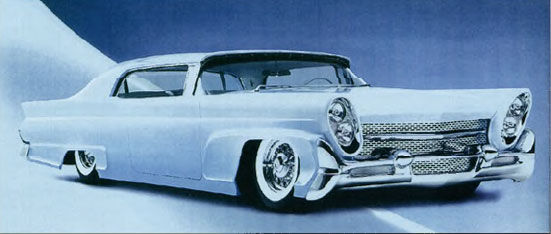
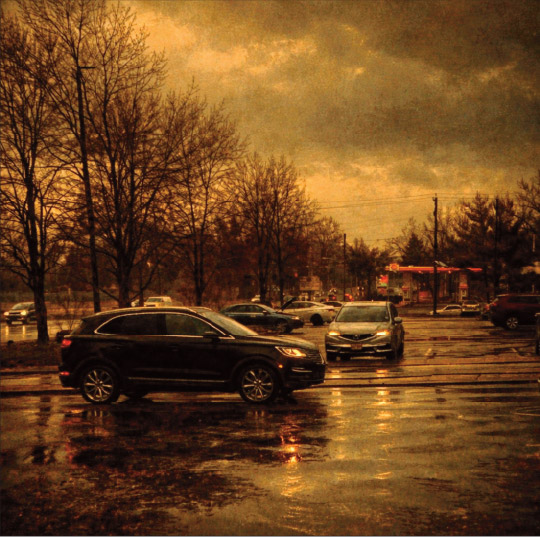
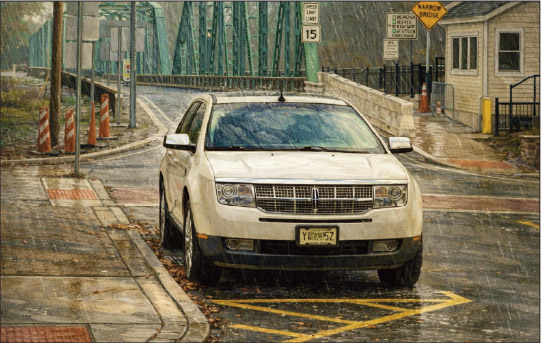
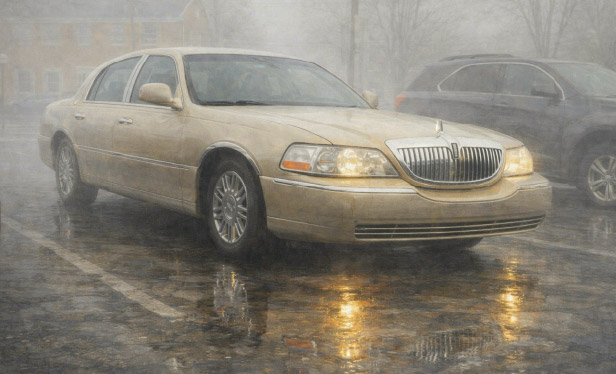
ABOVE:  “Early Spring Rain”

Originally published in the May-June 2026 Lincoln and Continental Comments magazine (Issue # 390)

By Bill Wolf

These days, it seems AI is on everybody’s mind. In five years, it will eliminate 90% of white-collar jobs, don’t you know. At the touch of a button, someone overseas can create a flawless issue of the Lincoln and Continental Comments in seconds without the quirks of a temperamental human editor, photographer, or art director. One can only imagine the deleterious effects on the local coffee economy here in Kokomo were that to happen!
The one thing that we have to remember is that AI is a tool. Like any tool, it is only as good as its operator. Give me a paintbrush and palette, no matter their quality, and with all the skill I can muster, I will never be the next Edward Hopper, Grant Wood, or Thomas Hart Benton. At the same time, with a battered old Underwood typewriter, a dictionary, and some correction fluid, I can craft prose that can take you into a special world that only my words can create.
In the right hands, AI can be a useful tool. I use it as one of many proofreading methods for this and other magazines. But I don’t blindly rely on it, and this is key. Like any other tool, one must understand its limitations and work within them.
The author of this article, Bill Wolf, has written for me at The Self-Starter for many years. Last year, he joined the LCOC and wrote an article about the Lincolns he spotted on a trip to New York City. No matter the publication, Bill always finds something interesting to comment upon.
What follows are some of Bill’s artistic creations. It helps me if I think of this as someone who works in the medium of “ones and zeros” rather than watercolors. But the idea is the same. A still life is a painting of one person’s perception of a place or thing at a particular moment in time. AI is faster, but it is still an interpretation through a lens, albeit a silicon one, tinted by human experience. Now, let’s enjoy what Mr. Wolf has cooked up for us today!- Ed.

Yes. I know. I left myself quite open. There may be some of you out there, philosophically or curmudgeonly, who would like to tell me exactly what I can do with AI. Pfui! AI will ruin everything. You look at a photo in a car club magazine, and now you can’t tell if it is real or not. Here is someone, someone crafty, bragging that there are only three of these rare Lincoln coupes in existence—and showing a handful of photographs of a very peculiar car and, also, scans of documents from FMC and some obscure coachbuilder from Wisconsin. Nope! Everything looks real as real can be, but it whispers and shouts of fakery, chicanery. How soon will it be before we are absolutely certain that we will be absolutely unable to distinguish the real from what is not? Oh, sure, the history of photography has a chapter on manipulation and weird darkroom effects, but it is light-years away from the AI-graphy of today. Let us just imagine what the next few generations of AI will bring. We do know that it will inevitably—however, whenever, whatever— bring both the yin and the yang, the light and the darkness. But today, let us set aside our concerns and objections; let us now focus on the entertaining side of AI technology.
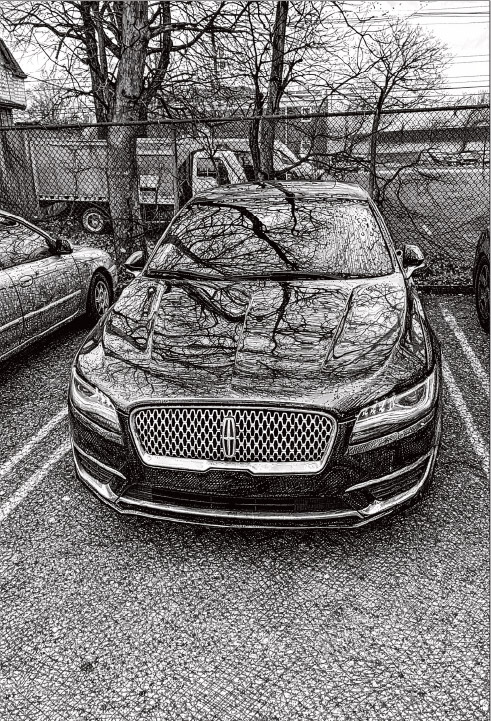
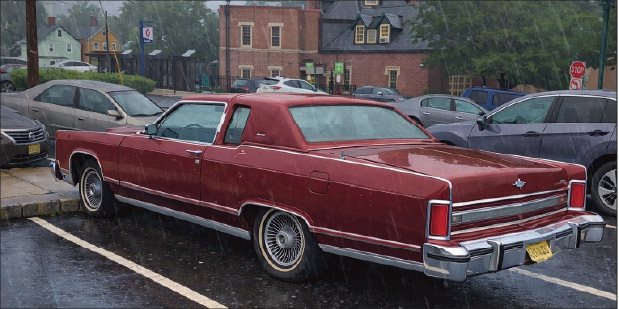
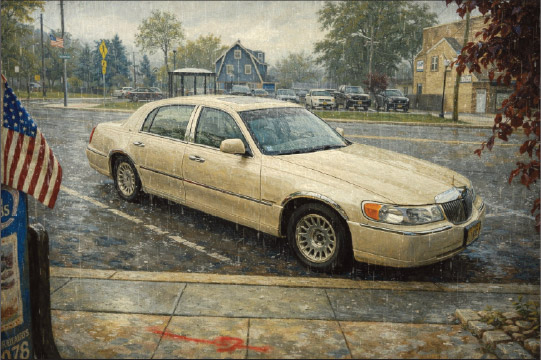
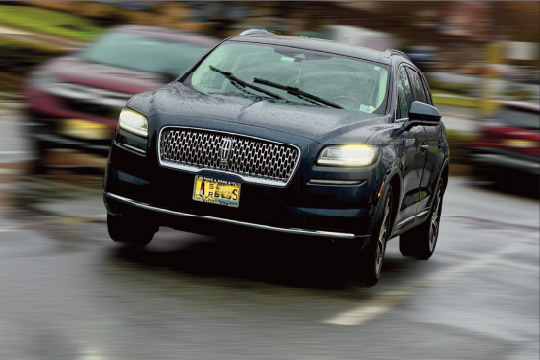
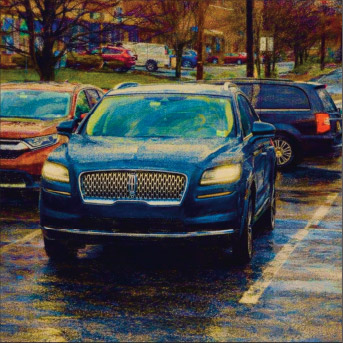
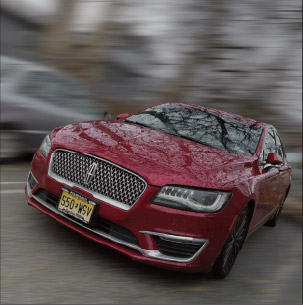
Rainy day. Sky of gray. And whilst driving through some connecting New Jersey towns and neighborhoods, I found my share of Lincolns. (Some of these cars are decades old and still in service.) When the weather comes damp and gray, it adds une touche romantique.
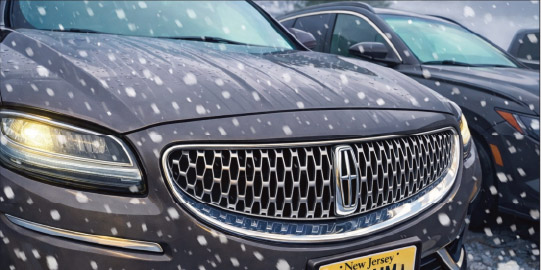
So when a Lincoln would show its grille or taillights in a parking lot or on the road, I snapped. And later, going through my files, I found some favorite photos shot on clear, sunny days. But I wanted to keep the stormy weather as a thematic element for this brief pictorial. So I chatted with ChatGPT—and found there a competent rainmaker. But why stop there? Add a touch of the Old Masters’ painting techniques. Add a touch of Walt Disney or a heavy nod to Norman Rockwell. AI handled all of these easily, and as it chatted with me, offering suggestions or clarifying my requests, we had some absorbing conversations. We found some amusement and compiled this sweet collection of Lincoln-themed gems. At this point, we can’t even call one of these creations, these collaborations between me and the machine, a photograph any longer. Image? Metaphor? Artistry? Simulacrum? Fabulation?

Bill Wolf is an LCOC member from Union, New Jersey.

ABOVE:  “Duer Lincoln”

ABOVE: “Yellow Skies”

ABOVE:  “Keep smiling no matter what”

ABOVE: “Couple in the rain”

ABOVE: “Narrow, Rockwellian Bridge”

ABOVE: “A Study for the old Saturday Evening Post?”

ABOVE: “Head of the Pack”

ABOVE: “Waiting out the weather”

ABOVE: “Foggy day in New Jersey”

ABOVE: “Looks like bad weather!”

ABOVE: “Track practice”

The Lincoln Sentinel

The Lincoln Sentinel

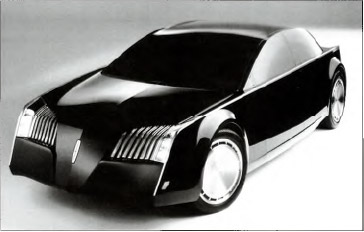
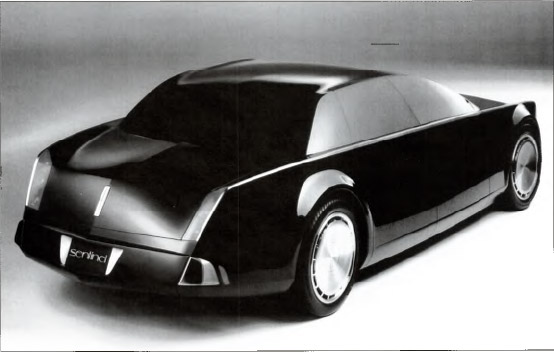
ABOVE: The grill is a new interpretation of 1940-41.  The total effects is F-117A Stealth Fighter.

From Carolyn Burke, Lincoln-Mercury Public Relations
Introduction by Jim Farrell.
Originally published in the May-June 1996 (#210) issue of Lincoln & Continental Comments magazine.

Prologue:  The Green Hornet Rides Again.

Last year, sources with ties to Ford’s Design Center reported that the aero/elliptical look of current Ford products was about spent and that new styling directions were on the horizon. What are future Lincolns going to look like? Planes are still one of the major influences on car design. The latest look in airplane design is the Stealth. Stylists at Ford’s Design Center describe their translation of the stealth look as “new edge” design.

The newest Lincoln concept car is the 1996 Sentinel. It was introduced to the public January 8, 1996, at the Detroit Auto Show. From its angular lines, it appears to have been heavily influenced by the F-117A Stealth fighter. To old car enthusiasts, the Sentinel may also evoke memories of “Black Beauty”, the modified 1937 Lincoln Zephyr used by the Green Hornet in the 1940 movie of the same name.

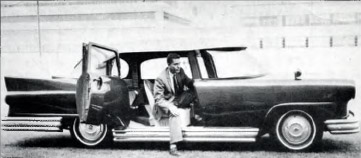
In March, 1996, after the Sentinel was shown at several east coast auto shows, the color was changed from black to charcoal gray. The stylists apparently felt that in black, the Sentinel looked too sinister. In present form, the Sentinel is a fiberglass “workout”. It has no drivetrain and no interior except for a steering wheel, the tops of the seats and the top of the dash. The doors, hood and trunk do not open. It is, however, designed to have suicide doors, (stylists call them “French doors”) Currently a new 7/8 size Sentinel is being built for display at the Pebble Beach Concours. The stylists also apparently felt that the sizing of the Sentinel as originally designed was too big. The new 7/8 Sentinel will be a fully operational vehicle. It will be built on a Jaguar platform and it will have “French doors” like the 1961-69 Lincoln Continentals.

A word of caution; just because a particular look is being considered for one of the Ford products in our future, it doesn’t necessarily mean it will come to pass.

Public reaction to the Lincoln Sentinel will be gauged carefully and in a couple of years, when we see the new Lincoln look —whatever it is—we’ll then know if Ford’s stylists have been able to translate the Stealth look into something the car buying public will take to. Jim Farrell.

The Lincoln Sentinel, a full-size, four-door, rear-wheel-drive luxury concept car, embodies what may be the wave of the future in automotive design.

Ford’s latest example of New Edge design, Sentinel makes its world debut at the 1996 North American International Auto Show in Detroit. Sentinel blends classic Lincoln styling themes with the Ford-inspired New Edge approach.

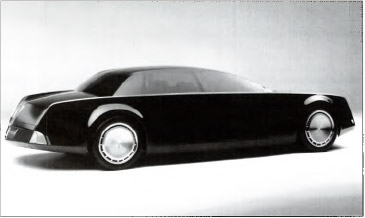
The blade fenders and high belt line with minimal chrome trim (above) harken back to design themes Lincoln used in the Sixties.

Sentinel retains the recognizable elements of traditional Lincoln exterior styling, such as classic proportions, a crisp silhouette, simple, unadorned body sides and high, linear belt lines. But New Edge’s “shape-upon-shape” technique results in edge highlights where curved planes intersect.

“The result is a strong, almost brutal shape that suggests strength,” said Jack Telnak, vice president, Corporate Design. “In this way, form contains function. The skin is wrapped tightly over the mechanicals, almost like shrink-wrap. The result is not only improved aerodynamics, but also improved fuel economy as well as head-turning styling,” Telnack said.

New Edge is not a new concept for Ford. The GT90 sports car, which was introduced last year, is one of the first applications of Edge design in a car seen by the public.

“The GT90 captured the feel of the original GT40, but with a distinct difference,” Telnack said. “It is a contemporary iteration that uses styling cues from the ‘60s in a whole new way—a three-dimensional ‘90s interpretation.

“So, New Edge is not a retro style. It is a true forward application, but one that pays homage to the past. New Edge is but one of several emerging design concepts. It is a harbinger of things to come, but it is not the only path.

“Like the breadth of our car and truck lines, we have a similar breadth in our design philosophies. There are other equally exciting design avenues we are pursuing,” said Telnack.

Lincoln enthusiasts will recognize a new interpretation of a 1940s-style Continental grill set into the Sentinel’s metallic black exterior. The clean side profile, blade fenders and high belt line with minimal chrome trim are typical Lincoln design themes that are reminiscent of early 1960s Lincolns and still are clearly visible in today’s Town Car.

Flush glass all around and compact, vertically stacked projector headlamps add to the uncluttered look of the exterior. The placement of the flush-to-the-body, massive, 20-inch wheels ensures a minimum of body overhang and adds to Sentinel’s clean lines. The car’s overall length of 218 inches is just one inch shorter than a 1996 Lincoln Town Car.

“The Lincoln Sentinel is an exploratory look at keeping Lincoln’s traditional styling themes fresh for future generations,” said Claude Lobo, Ford’s director of Advanced Design.

“But the Sentinel also is helping us to identify important issues in auto design, such as determining the benefits of a New Edge approach. Improved road holding and interior space are two more areas that may benefit from this kind of design approach in the future,” Lobo said.

The rear treatment is completely new. While some o f the styling cues go back to classic Lincoln Continentals, the entire car breaks new ground in automotive styling.

Solving Vapor Lock in my 1960 Lincoln Continental Mark V

Originally published in the March-April 2026 Lincoln and Continental Comments magazine (Issue # 389)

By Dean Forbes

Vapor lock can be annoying and frustrating, to say the least. Coupled with Ensign Murphy’s law, vapor lock will always occur at the worst possible moment. Even many mechanics don’t fully know how to approach the problem. I don’t recall ever having seen an in-depth article on the subject, although there have been some good suggestions in Lincoln and Continental Comments in the past.

Can vapor lock really be cured? We will not confine ourselves to just Lincolns and Continentals in these tips, since the same basic cause and cure apply to every gasoline-powered car on the highway. Vapor lock is caused by only two factors: too little fuel pressure or too much heat. Either causes the gas in the fuel pump and line to boil, creating vapor. Also, modern-day blended fuel containing ethanol tends to vaporize more easily.

Figure 1

The place to start is to have a mechanic take a fuel pump pressure and volume test. Four pounds minimum is a rule of thumb, but check the spec for your car. If the car is an older one, hand the mechanic a 3/8” or 5/16” clear plastic hose. If you can see bubbles, it indicates a fuel line that is rusted through. Also, have the mechanic check the fuel filter, radiator, fan belt, fan shroud, and fan clutch (if used). You should also consider a fan with more blades that will pull more air.

Many cars, including some Lincolns in the 1960s and some Chrysler products, have a vent system to prevent vapor lock. If this is plugged or disconnected, fix it. If you correct these items as needed and it still vapor locks, you may have to install an electric fuel pump near the gas tank with a control switch on the dash. This will cure many vapor lock problems, but I didn’t want to drill a hole in my dash, so I started looking at the placement of the fuel pump on the 430 CID V-8. What a strange location indeed, with the pushrod-operated pump, set high and forward on the engine, was repeatedly praised by auto writers at the 1958 previews. On first inspection, it seems to be an ideal location; it is certainly very serviceable and easy to replace.

Except anybody who has had a 1960 Lincoln vapor lock on a hot day will immediately understand the folly of putting the fuel pump in direct line with the hot radiator air. This vapor lock problem became more pronounced after 1961, when the under-hood space became even more restricted. The use of a pushrod should also have been recognized as a potential source of failure, following Ford’s experience with them on the original flathead V-8s. So why was the fuel pump put way out there?

According to former LCOC member Jim Crabtree, at an Edsel Owner’s Club meeting, he met an engineer who worked on the development of the 430 CID motor. This man answered many questions, but most importantly, he solved the fuel pump mystery. It seems that in 1952-1955, when the 1958 engines were being designed, the staff was told that all cars that were slated to use the 383/410/430 engine had been approved for electric fuel pumps built into the gas tank. At the last minute, the bean counters at Ford nixed the electric pump idea and insisted upon a mechanical version. The problem was that by the time the order came down the block, the design was already finalized, and there was simply no place to put a mechanical pump. Last minute re-engineering led to the high mounted, pushrod-operated, “breakdown waiting to happen” approach. The engineers knew all the potential problems, but placing the pump where it is required redesigning only the cam and front cover.

Figure 2

In the end, the bean counters were happy, but nobody else was. So, if chronic fuel system failures cause you to add an electric pump to your car, relax in the knowledge that this was how it was supposed to have been anyway.

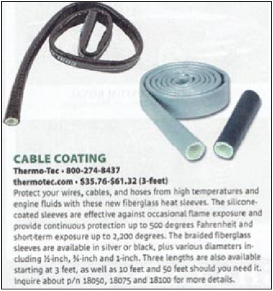
Again, I didn’t want to drill a hole in my dash for a switch to operate an electric fuel pump. I began looking for an alternative solution while still keeping the car factory-original. What I found was a new fiberglass heat sleeve by Thermo-Tech. (Fig.1) The company has been around since 1986, and its belief in Thermo-Tech products has made it the number one source for heat-management solutions.

In my 1960 Lincoln Continental Mark V Convertible, there is a 3/8“ diameter rubber fuel hose, approximately two feet in length, that runs from the metal fuel line up front to the fuel pump itself, which needs protection from excessive heat. So, I ordered the following:

QTY:1
Code/SKU: 17063
Product Name:  Thermo-Flex Sleeve
Color: Black
Size:  5/8″ x 3ft
Price: $23.50
SH: $5.00
Grand Total: $28.50

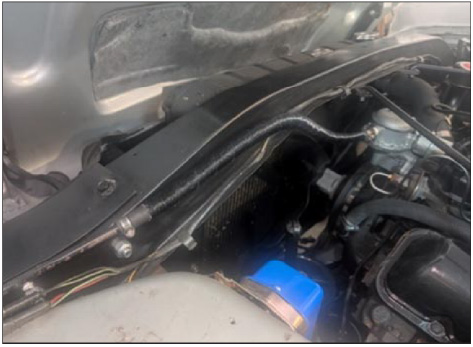
The rubber fuel line that needs protection is 3/8” in diameter. Sliding the 5/8“ Thermo-flex shield sleeve over the rubber fuel line makes for a nice and snug fit. By ordering three feet of the flex sleeve, I had one foot left over, which I then used to encase the metal fuel line from the fuel pump filter to the carburetor. (See Fig. 2) Since installation, I have not experienced another vapor lock issue. What a great find for only $28.50!

Dean Forbes is an LCOC member from Houston, Texas.

An Ethanol Story

An Ethanol Story

ABOVE: Dated August 9, 1940, this 1941 Lincoln V-12 engine is illustrative of the powerplant in the author’s Continental Coupe.  Photo courtesy of Continental Comments # 95.

By Dr. Charles Burton.  Submitted by Richard Koop
Originally published in the May-June 2020  (# 354) issue of Lincoln & Continental Comments magazine.

Recently I had a near-catastrophic occurrence with my 1948 Mercury Convertible’s fuel system, which is very similar to my 1941 Lincoln Continental fuel system. One afternoon, I drove my car hard up the mile-long road to our home and parked it in the garage attached to the house. The next morning, my son come over for coffee, and after raising the garage door and coming into the kitchen, he said: “there is gasoline on the floor in the garage.” My reply was that “all old cars smelled after being driven.” He said, “no,” I went and looked, and there was a large puddle of gasoline that had flowed from the engine area out from under the car. There was a large freezer less than four feet from the pool. I opened the other garage door and turned on a fan to blow the fumes out of the garage. I then used paper towels to absorb the gas that was not under the car. Looking under the car, I did not see any gas dripping. I called my expert old car mechanic, and we agreed a carburetor leak would not have produced such a large amount of gas overnight. Looking in the engine compartment, there did not seem to be any evidence of a leak.

Because of the pooled gas under the car, the Mercury had to be moved outside. Using a heavy rope attached to my truck, I pulled it out into the driveway. Since the driveway is up a hill out of the garage and with the front of the car pointed downhill, gas started dripping from around the engine oil pan onto the pavement. I put a container under the engine and cleaned up the garage puddle. inspection under the car revealed gas coming from the oil pan, where the oil tube attached. The gas was floating on top of the oil in the pan. The Mercury’s fuel pump is attached to the oil filler tube. It was clear that the rubber diaphragm inside the pump developed a tear. The auxiliary electric fuel pump had helped force gas into the oil filler tube and then into the engine. I have used non-ethanol gasoline since I’ve owned the car, but the previous owner had used ethanol gas, which is destructive to older rubber products. Our Lincoln’s stock V-12s don’t have an oil stick, and gasoline in the crankcase cannot leak out. However, some owners have converted their cars to Ford V-8s, so this is a genuine possibility for them.

My expert mechanic had an engine explode and burn. A similar scenario that caused that disaster had also happened in my Mercury. A new mechanical fuel pump should be rebuilt with ethanol-resistant components. You may reduce your chances of a catastrophe by using only the electric fuel pump and bypassing the original one. If you continue to use the mechanical pump, replace it if you have used ethanol gasoline. Turn off the auxiliary electric fuel pump when not needed, and pray this will not happen to you and your car. I am blessed I did not lose two vehicles and my home.

Dr. Burton is a retired 83-year-old surgeon from Macon, Ga. who practiced for 40 years. The 1941 Lincoln Continental was his dream and he purchased it in the 1970s from the original owner’s family.

ABOVE: A 1947 Mercury Convertible Coupe, similar to the author’s 1948 model.  From the Old Car Manual Project.