An Ethanol Story

An Ethanol Story

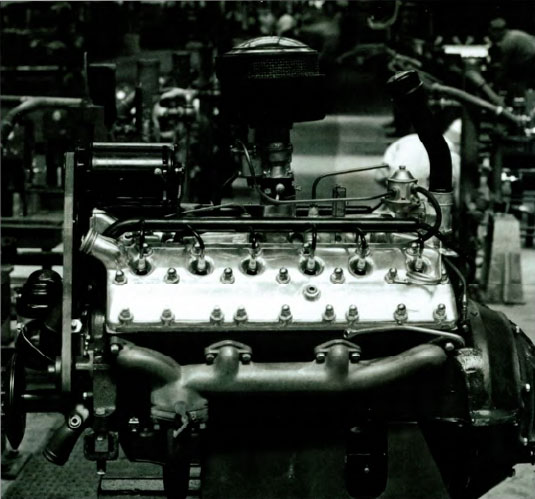
ABOVE: Dated August 9, 2940, this 1941 Lincoln V-12 engine is illustrative of the powerplant in the author’s Continental Coupe.  (Photo courtesy of Continental Comments # 95, Winter 1969.)

by Dr. Charles Burton
Submitted by Richard Koop

Originally published in the May-June 2020 issue of Continental Comments (Issue # 354.)

Recently I had a near-catastrophic occurrence with my 1948 Mercury Convertible’s fuel system, which is very similar to my 1941 Lincoln Continental fuel system. One afternoon, I drove my car hard up the mile-long road to our home and parked it in the garage attached to the house. The next morning, my son come over for coffee, and after raising the garage door and coming into the kitchen, he said: “there is gasoline on the floor in the garage.” My reply was that “all old cars smelled after being driven.” He said, “no,” I went and looked, and there was a large puddle of gasoline that had flowed from the engine area out from under the car. There was a large freezer less than four feet from the pool. I opened the other garage door and turned on a fan to blow the fumes out of the garage. I then used paper towels to absorb the gas that was not under the car. Looking under the car, I did not see any gas dripping. I called my expert old car mechanic, and we agreed a carburetor leak would not have produced such a large amount of gas overnight. Looking in the engine compartment, there did not seem to be any evidence of a leak.

Because of the pooled gas under the car, the Mercury had to be moved outside. Using a heavy rope attached to my truck, I pulled it out into the driveway. Since the driveway is up a hill out of the garage and with the front of the car pointed downhill, gas started dripping from around the engine oil pan onto the pavement. I put a container under the engine and cleaned up the garage puddle. Inspection under the car revealed gas coming from the oil pan, where the oil tube attached. The gas was floating on top of the oil in the pan. The Mercury’s fuel pump is attached to the oil filler tube. It was clear that the rubber diaphragm inside the pump developed a tear. The auxiliary electric fuel pump had helped force gas into the oil filler tube and then into the engine. I have used non-ethanol gasoline since I’ve owned the car, but the previous owner had used ethanol gas, which is destructive to older rubber products. Our Lincoln’s stock V-12s don’t have an oil stick, and gasoline in the crankcase cannot leak out. However, some owners have converted their cars to Ford V-8s, so this is a genuine possibility for them.

My expert mechanic had an engine explode and burn. A similar scenario that caused that disaster had also happened in my Mercury. A new mechanical fuel pump should be rebuilt with ethanol-resistant components. You may reduce your chances of a catastrophe by using only the electric fuel pump and bypassing the original one. If you continue to use the mechanical pump, replace it if you have used ethanol gasoline. Turn off the auxiliary electric fuel pump when not needed, and pray this will not happen to you and your car. I am blessed I did not lose two vehicles and my home.


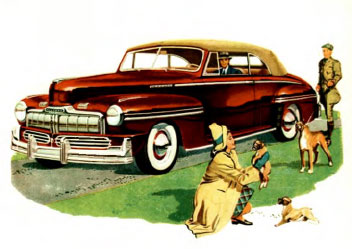
ABOVE: A 1947 Mercury Convertible Coupe, similar to the author’s 1948 model.  (From The Old Car Manual Project.)

Dr. Burton is a retired 83-year-old surgeon from Macon, Ga. who practiced for 40 years. The 1941 Lincoln Continental was his dream and he purchased it in the 1970s from the original owner’s family.

An Artist Speaks

An Artist Speaks

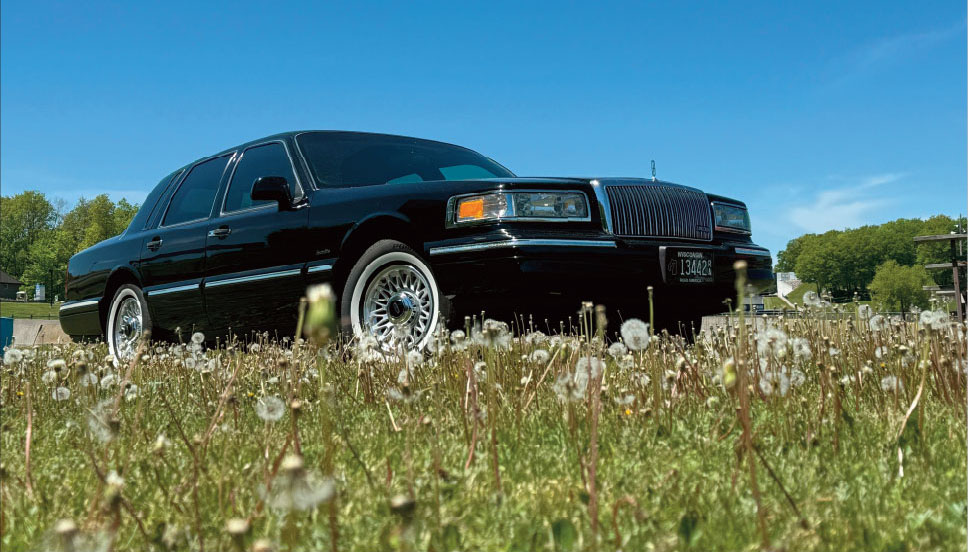
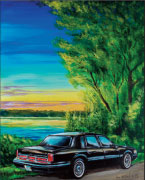
ABOVE:  Ken Madden’s prized 1997 Lincoln Town Car frolicking in a field of fresh flora.

By Ken Madden

Originally published in the March-April 2025 Lincoln and Continental Comments magazine (Issue # 383)

Photos courtesy of the author.

Let me tell you what brought me to Lincolns. Lincoln builds cars for the affluent and successful members of our great country. These are people who have worked all their lives, building estates worthy of leaving a legacy for the children to enjoy for generations. A  Lincoln was, and still is, a big part of that.

On the other side of the tracks was me, in 1995. I was broke and soon to be a dad. Unmarried and working at Wizard Custom Studios in Andover, Minnesota. We restored cars and built very cool custom cars as well as motorcycles. At the time, I was driving a 1968 Ford Ranchero GT with a four-speed and a 302! It sounds awesome, but this was the epitome of a beater.

So, I had no money and needed a better and safer way to haul around my newborn daughter. Alas, a friend of the shop had a car for me- a 1982 Lincoln Town Car. It was brown with a tan velour interior and was rusty, but it ran and drove perfectly…almost.

I was in New Hope, Minnesota, and the car was in Ripon, Wisconsin, about five hours away. Here is the “almost” part. The exhaust was gone from the driver’s seat back. Let’s just say it was a rather loud ride back, but for $350, I was not complaining! I drove that poor old girl for many years, and all I ever needed to fix were rust-related things like all the brake lines.

Sometimes, you look back on the things you did in your youth and wonder how you survived. Consider the gas lines on a car exposed to many salty upper Midwest winters. It was -15 degrees F, and I needed to replace the high-pressure line from the tank, along the frame to the engine, in the driveway. So I found a bunch of cardboard, placed it around the bottom of the car to stop the wind, pointed a kerosene torpedo heater under the car, and went to work. How that didn’t explode is truly an act of the almighty God!

All that said, what a great car! I was hooked. In 1997, my father retired and bought a brand-new black Town Car. I instantly told him that if he ever wanted to sell it, I would get first dibs, knowing full well that he would have it for many years. That was good, because I had no way to buy that car for years.

In 2015, he called and asked if I still wanted “that old Lincoln,” as he had bought a newer 2007 Town Car that caught his eye one day. Of course, I jumped at the chance. He gave me the car with the caveat that he would get half of the proceeds if I sold it. He knew I would never sell it. Over the years, we drove the 1997 Town Car from Wisconsin to Arizona, where my folks live many times. He passed away in October 2022, knowing his prized car was in good hands.

Dad’s Town Car is how the LCOC found me. I attended a couple of our shows over the years, and finally, in 2023, I joined up! To be honest, I didn’t think the Club would be as accepting as they all are! I mean, this ’97 isn’t a 1956 Continental Mark II or a 12-cylinder Continental. It’s just a ’90s Lincoln. Heck, they made a ton of these! But there I was, and the Club has been so welcoming, treating me like they have known me for decades.

I wanted to give back somehow. I helped at shows and co-admined the Northstar Region’s Facebook page gladly, but wanted to do more.
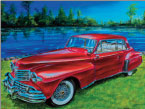
I am, first and foremost, an artist. I have an unrelenting passion for cars, so automotive art is my focus. I have done hundreds of portraits of some great cars of all makes and models. If you read this far and are interested, take a look at my website, maddkstudio.com. What you will see is 40 years of practice and love for the craft of illustration. Then it hit me- I can do an original painting of the “Best of Show” winner at our annual Northstar Region show in Hugo, Minnesota!

This past year’s winner was a spectacular 1948 Continental. What a car! So, I created a 16″ x 20″ acrylic painting on stretched canvas. And I felt like I at least made one man’s day with something very special, more than a nice trophy and handshake. This is something that tells a story. A painting spurs conversation and evokes memories of great and not-so-great times. It tells the story of a life just from an image.
I write this to tell everyone who reads this that so often, a car club is just a car club. I’ve been in dozens of them over the years. When you find a club like the LCOC, where fascinating folks with similar interests and hobbies meet, you also find a community that stands the test of time.

Speaking of time, I want YOU to take the time to talk to the younger Lincoln enthusiasts and encourage them to join our merry band of highway cruising, luxury riding, freedom machines. I am relatively new to the LCOC, and finding a home in the car world is priceless, so let’s spread the word!

INSET ABOVE:  The artist’s 1997 Town Car on canvas.The author created this stunning painting of the “Best of Show” winner at the Northstar Region’s show in Hugo, Minnesota.

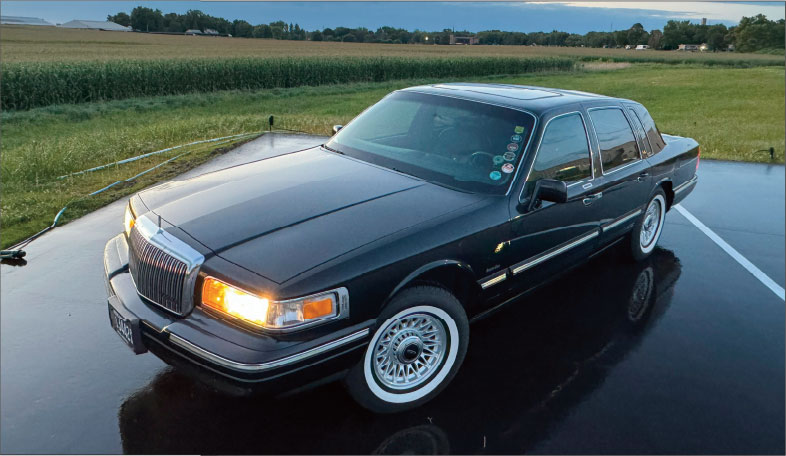
ABOVE:  The author’s ‘97 Town Car in repose.

Ken Madden is an LCOC member from Baldwin, Wisconsin.

Old School vs New School: Ideas on Carburetion

Old School vs New School: Ideas on Carburetion

by Charles Clark

Originally published in the May-June 2020 issue of Continental Comments (Issue # 354.)

Among old car aficionados who do restorations, there is a tug-of-war that goes on. Pulling in one direction are the purists who strive to make the car exactly as it came out of the factory. They obsess not only over “matching numbers”, but also over inspection paint marks on the frame. Those details have nothing to do with how the car runs. Instead, it has to do with the compulsive nature of the restorer. They insist on a level of perfection, which, in a lot of cases, never existed. Corvette restorers perhaps epitomize that approach. On the opposite end of the spectrum are those who seek to “upgrade” the car by modernizing various systems, such as engine carburetion and brakes. At the far end of this spectrum, we have the “restomod” where only the body is saved, and almost everything else is replaced with modern systems.

Our local LCOC region has members of each type, but the emphasis seems to be more on preserving and driving the car while having some personal enjoyment with it. I have engaged in both aspects of the hobby. With my 1940 Lincoln-Zephyr Continental Cabriolet (whew), I strived to do an exact restoration. Why else would I pay $500 for an air cleaner or $300 for an original taillight, and let’s not even talk about the NOS steering wheel? My goal was to make the car just like it came off the showroom floor. But this is 2020, not 1940 and things have changed. Thanks to our beloved “corn gas” and its ten percent alcohol content, if you want to drive the car
here in the Centennial State on a hot day at this altitude, it is essential that you have either an auxiliary electric fuel pump or good hiking shoes when the car vapor locks. Unless the car is to be a permanent resident at the Forney Transportation Museum in Denver, Colo, it must have the electric pump. Otherwise, the Lincoln is as close as I can make it to factory original.

The Continental is, therefore, in line with the stated purpose of the LCOC, which is to preserve the various Lincoln and Continental models. The emphasis is on exact restoration with judging and awards that foster this end. I am proud to say I have received some of those awards, even though I had to take some liberties by making modifications for the sake of practicality.

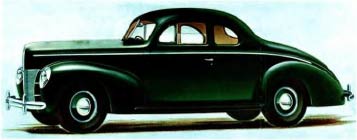
My 1940 Ford Coupe is at the other end of the spectrum. It looks original, but it has a modern overhead-valve, fuel-injected engine, power disk brakes, independent front suspension and a nine-inch rear-end, plus air conditioning. It is not quite a “restomod,” but it certainly is a “hot rod.” It required special skills beyond my ability to build each car. Machining the engines, painting and upholstery are tasks that require craftsmen regardless of your objective for the final restoration.


I have become heavily involved with carburetion in both “restored” and “upgraded” cars. I use the word “carburetion” in its most basic definition, which is the mixture of air and fuel to provide an optimally combustible vapor. Once the mechanics of the engine have been established, such as bore and stroke, camshaft profile and valve train, there is only ignition timing and carburetion left to determine the ultimate performance of the engine. The design approach to carburetion will have a significant effect on the performance of a car. It took me many years to study and to practice how to carburete an engine optimally. I am still learning.

The “old school” way to carburete a car is to use what we commonly call a “carburetor,” or just carb for short. The “new school” way is to use electronically controlled fuel injection (FI). What may not be obvious is while they both do the same thing, they do it by different methods. A “throttle body” style of FI presents an appearance very similar to a carb.

Why the change? To make the carb engine run at high altitudes here in Colorado, you need to change jets and metering rods. This requires mechanical assembly and some trial and error with replacement parts to get the car to run optimally. You also have to set a fussy thermostatic spring choke to get it to start and run when cold. There is also a power pump and fuel bowl needle valves, which need attention. Fuel starvation due to vapor lock is a common problem.

With FI, you have to make changes to the fuel pump and plug in some new sensors to measure engine performance. Once that is done, a computer takes over and provides the exact amount of fuel the engine requires based on what the sensors measure. There is nothing to change or to adjust with temperature or altitude.

For a judged show car, you want to keep the carbs. For a more regular driver, there is a good argument to convert to fuel injection. The issue then is not so much old school versus new school, but rather what your expectations are for the driving experience with the car and how dedicated you are to the exactness of restoration. That said, be prepared for controversy as “old school” aficionados do not give in to “new school” easily. In fact, they never give in!