
If You Got ‘Em…Drive ‘Em!
Originally published in the September-October 2019 (# 350) issue of Lincoln & Continental Comments magazine.
By George Masters
For those of you that are veterans and remember the old smoke break term, “If you got ’em, light ’em up”, I now refer to our classic cars, and the emphasis here is “cars,” plural.
We recently took in a car that has been in this guy’s garage since 1998. He hasn’t started it nor has he driven this car since the bodywork, wiring, and paint were completed back then. It just sat in his garage needing the finishing touches done. I’d ask him every year or so, “How’s the car coming along?” He’d always shake his head and smile. Well, last April, I asked him that question, and surprisingly, he told me that he was ready to move onto the next step, which was getting the interior done. To secure the deal, I told him I would need $1,000 down, and then I could get it into the upholsterer’s schedule. Sure enough, the deal was struck and scheduled for late summer 2019. I insisted that it be ready and running. “No problem,” he said. “I’ll have some of my buddies get it running.” Well, long story short, when we went to pick up the car, it would not start, so I got the truck and trailer and hauled it to my shop. Since it was not running, we took the bowl off the carburetor and guess what? There was sludge and gunk in the bowl. This was just the beginning. We wound up pulling the fuel tank, replacing the sending unit, cleaning out the fuel line, replacing the fuel pump, changing the fuel filter, and even buying a new carburetor. Then it was running!
My point is, why do we have these cars? Why do we have one, or two or more cars? Is it the prestige of being able to tell our friends which cars we own? Is it for the investment? Are we saving them for our children or grandchildren?
I have another story. My buddy had a beautiful car which he babied, washed often, waxed regularly, and generally treated it like a king would. He decided to buy a newer one and took his “Pride and Joy” to the dealer where he traded it. After we unloaded it, the car sat outside on the lot for three weeks exposed to the elements. Did he enjoy his ownership? Well, I’m sure he did, but for whom did he save it? I know another fellow who also has a beautiful car, and it just sits. He doesn’t take it out but maybe once a year. If there are clouds in the sky, it stays in.
So, in summary, I’m asking you to think about why you own one or more collectible cars. They were made to be driven, so think about your beauties and, “if you got ’em, drive ’em’!”
George Masters is a member from Minot, N.D.
New Benefits of Ford’s X Plan for LCOC Members
Originally published in the March-April 2025 Lincoln and Continental Comments magazine (Issue # 383)
For over a decade, Ford has offered all LCOC members the ability to use the X Plan program to obtain substantial discounts on new Ford or Lincoln vehicles. Over the years, hundreds of our members have used this plan not only to save on the price of the car, but also on fees, as the X Plan limits the dealer to a document fee cap of $100. It’s a great help when you are in the market for a new car or truck.
Recently, Ford has made the LCOC a full-fledged Partner Recognition member. That means that all our members can now get their own X Plan PINS! Just follow these simple steps to generate your X-Plan PIN:
- Visit www.fordpartner.com and enter our LCOC Partner Code – D5FGG
- Click on “GENERATE MY PIN” and enter your information to receive your LCOC X-Plan PIN.
- Bring your PIN Certificate along when visiting an eligible participating dealer, as well as proof of LCOC membership and the date of membership (month/year). Note that you must have been an LCOC member for at least 90 days.
The proof of LCOC membership can be one of the following: (1) Screen print of your membership information from Cornerstone, our membership manager. Go to www.lcoc.org, click on “Member Login” on top of home page, and sign in for the required information. (2) Your welcome letter from Cornerstone, or (3) The latest issue the Lincoln and Continental Comments with your address on the back cover. A photocopy is acceptable. If you have any questions, get back to me at gkramer2047@gmail.com or 832-368-2575. Good luck!
Hoosier Newsletter – Spring 2025
Leno’s Law
By Jeff Shively
Originally published in the May-June 2025 Lincoln and Continental Comments magazine (Issue # 384)
Photos courtesy of the author.
Sometimes, it helps to have friends in high places. Most Americans have a high opinion of Jay Leno. As the host of The Tonight Show, he tended to poke fun at the foibles of both sides of the aisle, much like Johnny Carson before him. His point was to entertain without alienating a large portion of the audience. In recent years, he has been known more as a car guy’s car guy. Through his television and YouTube programs, he has introduced many more people to the world of the collectible automobile than any one of us ever could, and for that we owe him a debt of gratitude.
Now, he is helping out again. Member Dean Forbes sent in a clipping from a recent issue of Old Cars magazine regarding California Senate Bill 712, dubbed “Leno’s Law.” California has the most stringent emissions standards of the 50 states. This might have made sense 50 years ago, when cars generally polluted more, and there were simply more of them in greater concentrations in California’s urban areas. Even as cars have gotten cleaner, the Golden State has had standards far in excess of other states, at least ones that haven’t adopted California standards.
A car must pass rigid emissions standards to be licensed in the state. To a certain extent, this makes sense for vehicles driven 10,000 or 20,000 miles annually on California’s crowded freeways. Applying those same standards to vintage cars that are seldom used makes less sense. As a result, there has been, for many years, an exemption in place for such cars. But this raises the question of how old a vehicle must be to be considered vintage. I recall reading about this debate as a high school junior and novice car guy in 1990 in the pages of Classic Auto Restorer, Cars & Parts, and Collectible Automobile. At the time, it was a question of deciding between a hard date that never changes or a rolling exemption. I think 1975 might have been the cutoff in those days, a mere 15 years before the current date.
Today, collector cars built prior to 1976 are exempt from California’s biennial smog checks. The current cutoff is fine for people who like 1940s, 1950s, and 1960s cars. Nothing will change for them. What has changed is the scope of collectability within our hobby. Compare the show field at last fall’s Eastern National Meet with the lineup in 1995. Where Gregorie’s gorgeous 1940-1948 Continentals, silky Continental Mark IIs, and Elwood Engel’s masterworks once dominated, Bill Blass Mark Vs, 1980s Town Cars, and sleek Mark VIIIs rule the day. The same is true in almost every corner of the hobby. 1970s and newer cars have grown exponentially in popularity over the past 20 years.
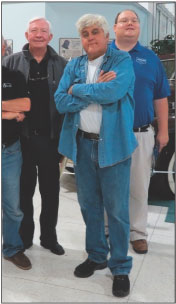
ABOVE Jay Leno during a 2014 visit to the Kokomo Automotive Museum.
The sponsor of S.B. 712, Sen. Shannon Grove (R. Bakersfield), says that it targets “unnecessary and burdensome smog check requirements for classic vehicles, ensuring they remain a celebrated part of California’s culture and economy.” Currently, vehicles that are at least 35 years old can be exempted from the smog check, provided that they are insured as collector automobiles, comply with the emissions regulations of the year they were built, pass a functional test of the gas cap, and have no visible fuel leaks. Leno’s Law simply seeks to replace the fixed date of 1976 for total exemption from smog checks to a rolling date of 35 years old. “California’s smog check laws for classic cars need to be updated – they vary too much from state to state, and California’s rules don’t match up with neighboring ones,” said Leno.
This is just common sense. The newest car that would be fully exempted today would be a 1990 model. Some opponents might say that this would open up a loophole allowing people to drive “gross polluters” every day. True, you can drive a 1990 Lincoln every day. There would probably be someone driving a junkyard refugee, but most people who own them wouldn’t do that because they see them as fun cars for occasional use. I am also old enough to remember when some of the same people who will now call a 1990 Mark VII a “gross polluter” wanted folks to surrender their 1975 Mark IVs and replace them with brand-new “clean and efficient” 1990 Lincolns when I was a teenager.
In reality, this regulation doesn’t affect Mr. Leno that much. Most of his collection has been exempt for decades. Like many of us, he understands the importance of expanding the reach of the hobby beyond its current boundaries. Buying a slab side Continental is not in everyone’s budget, but a nice 1990 Town Car (Motor Trend’s Car of the Year) might be the perfect balance of affordability and practicality, with a lot of class. Hopefully, the California Senate will join with Sen. Grove, pass this S.B. 712, and provide some relief for our collector car compatriots in the Golden State.
Jeff Shively, LCOC legislative advocate, lives in
Kokomo, Indiana