The Lincoln Sentinel
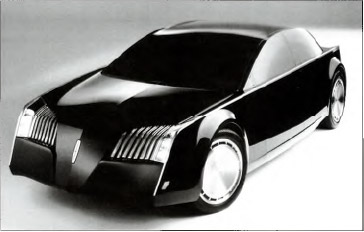
ABOVE: The grill is a new interpretation of 1940-41. The total effects is F-117A Stealth Fighter.
From Carolyn Burke, Lincoln-Mercury Public Relations
Introduction by Jim Farrell.
Originally published in the May-June 1996 (#210) issue of Lincoln & Continental Comments magazine.
Prologue: The Green Hornet Rides Again.
Last year, sources with ties to Ford’s Design Center reported that the aero/elliptical look of current Ford products was about spent and that new styling directions were on the horizon. What are future Lincolns going to look like? Planes are still one of the major influences on car design. The latest look in airplane design is the Stealth. Stylists at Ford’s Design Center describe their translation of the stealth look as “new edge” design.
The newest Lincoln concept car is the 1996 Sentinel. It was introduced to the public January 8, 1996, at the Detroit Auto Show. From its angular lines, it appears to have been heavily influenced by the F-117A Stealth fighter. To old car enthusiasts, the Sentinel may also evoke memories of “Black Beauty”, the modified 1937 Lincoln Zephyr used by the Green Hornet in the 1940 movie of the same name.
In March, 1996, after the Sentinel was shown at several east coast auto shows, the color was changed from black to charcoal gray. The stylists apparently felt that in black, the Sentinel looked too sinister. In present form, the Sentinel is a fiberglass “workout”. It has no drivetrain and no interior except for a steering wheel, the tops of the seats and the top of the dash. The doors, hood and trunk do not open. It is, however, designed to have suicide doors, (stylists call them “French doors”) Currently a new 7/8 size Sentinel is being built for display at the Pebble Beach Concours. The stylists also apparently felt that the sizing of the Sentinel as originally designed was too big. The new 7/8 Sentinel will be a fully operational vehicle. It will be built on a Jaguar platform and it will have “French doors” like the 1961-69 Lincoln Continentals.
A word of caution; just because a particular look is being considered for one of the Ford products in our future, it doesn’t necessarily mean it will come to pass.
Public reaction to the Lincoln Sentinel will be gauged carefully and in a couple of years, when we see the new Lincoln look —whatever it is—we’ll then know if Ford’s stylists have been able to translate the Stealth look into something the car buying public will take to. Jim Farrell.
The Lincoln Sentinel, a full-size, four-door, rear-wheel-drive luxury concept car, embodies what may be the wave of the future in automotive design.
Ford’s latest example of New Edge design, Sentinel makes its world debut at the 1996 North American International Auto Show in Detroit. Sentinel blends classic Lincoln styling themes with the Ford-inspired New Edge approach.
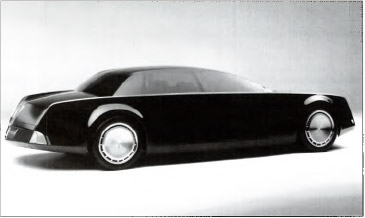
The blade fenders and high belt line with minimal chrome trim (above) harken back to design themes Lincoln used in the Sixties.
Sentinel retains the recognizable elements of traditional Lincoln exterior styling, such as classic proportions, a crisp silhouette, simple, unadorned body sides and high, linear belt lines. But New Edge’s “shape-upon-shape” technique results in edge highlights where curved planes intersect.
“The result is a strong, almost brutal shape that suggests strength,” said Jack Telnak, vice president, Corporate Design. “In this way, form contains function. The skin is wrapped tightly over the mechanicals, almost like shrink-wrap. The result is not only improved aerodynamics, but also improved fuel economy as well as head-turning styling,” Telnack said.
New Edge is not a new concept for Ford. The GT90 sports car, which was introduced last year, is one of the first applications of Edge design in a car seen by the public.
“The GT90 captured the feel of the original GT40, but with a distinct difference,” Telnack said. “It is a contemporary iteration that uses styling cues from the ‘60s in a whole new way—a three-dimensional ‘90s interpretation.
“So, New Edge is not a retro style. It is a true forward application, but one that pays homage to the past. New Edge is but one of several emerging design concepts. It is a harbinger of things to come, but it is not the only path.
“Like the breadth of our car and truck lines, we have a similar breadth in our design philosophies. There are other equally exciting design avenues we are pursuing,” said Telnack.
Lincoln enthusiasts will recognize a new interpretation of a 1940s-style Continental grill set into the Sentinel’s metallic black exterior. The clean side profile, blade fenders and high belt line with minimal chrome trim are typical Lincoln design themes that are reminiscent of early 1960s Lincolns and still are clearly visible in today’s Town Car.
Flush glass all around and compact, vertically stacked projector headlamps add to the uncluttered look of the exterior. The placement of the flush-to-the-body, massive, 20-inch wheels ensures a minimum of body overhang and adds to Sentinel’s clean lines. The car’s overall length of 218 inches is just one inch shorter than a 1996 Lincoln Town Car.
“The Lincoln Sentinel is an exploratory look at keeping Lincoln’s traditional styling themes fresh for future generations,” said Claude Lobo, Ford’s director of Advanced Design.
“But the Sentinel also is helping us to identify important issues in auto design, such as determining the benefits of a New Edge approach. Improved road holding and interior space are two more areas that may benefit from this kind of design approach in the future,” Lobo said.
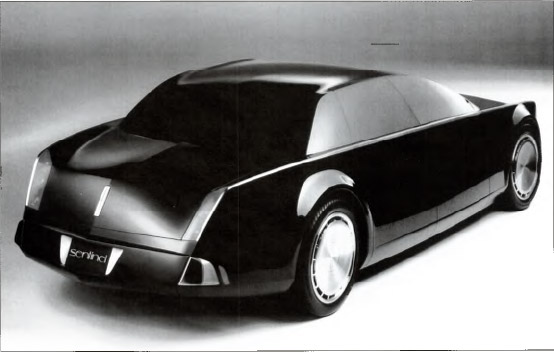
The rear treatment is completely new. While some o f the styling cues go back to classic Lincoln Continentals, the entire car breaks new ground in automotive styling.