
Originally published in the March-April 2026 Lincoln and Continental Comments magazine (Issue # 389)
By Dean Forbes
Vapor lock can be annoying and frustrating, to say the least. Coupled with Ensign Murphy’s law, vapor lock will always occur at the worst possible moment. Even many mechanics don’t fully know how to approach the problem. I don’t recall ever having seen an in-depth article on the subject, although there have been some good suggestions in Lincoln and Continental Comments in the past.
Can vapor lock really be cured? We will not confine ourselves to just Lincolns and Continentals in these tips, since the same basic cause and cure apply to every gasoline-powered car on the highway. Vapor lock is caused by only two factors: too little fuel pressure or too much heat. Either causes the gas in the fuel pump and line to boil, creating vapor. Also, modern-day blended fuel containing ethanol tends to vaporize more easily.
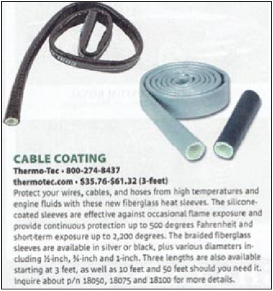
Figure 1
The place to start is to have a mechanic take a fuel pump pressure and volume test. Four pounds minimum is a rule of thumb, but check the spec for your car. If the car is an older one, hand the mechanic a 3/8” or 5/16” clear plastic hose. If you can see bubbles, it indicates a fuel line that is rusted through. Also, have the mechanic check the fuel filter, radiator, fan belt, fan shroud, and fan clutch (if used). You should also consider a fan with more blades that will pull more air.
Many cars, including some Lincolns in the 1960s and some Chrysler products, have a vent system to prevent vapor lock. If this is plugged or disconnected, fix it. If you correct these items as needed and it still vapor locks, you may have to install an electric fuel pump near the gas tank with a control switch on the dash. This will cure many vapor lock problems, but I didn’t want to drill a hole in my dash, so I started looking at the placement of the fuel pump on the 430 CID V-8. What a strange location indeed, with the pushrod-operated pump, set high and forward on the engine, was repeatedly praised by auto writers at the 1958 previews. On first inspection, it seems to be an ideal location; it is certainly very serviceable and easy to replace.
Except anybody who has had a 1960 Lincoln vapor lock on a hot day will immediately understand the folly of putting the fuel pump in direct line with the hot radiator air. This vapor lock problem became more pronounced after 1961, when the under-hood space became even more restricted. The use of a pushrod should also have been recognized as a potential source of failure, following Ford’s experience with them on the original flathead V-8s. So why was the fuel pump put way out there?
According to former LCOC member Jim Crabtree, at an Edsel Owner’s Club meeting, he met an engineer who worked on the development of the 430 CID motor. This man answered many questions, but most importantly, he solved the fuel pump mystery. It seems that in 1952-1955, when the 1958 engines were being designed, the staff was told that all cars that were slated to use the 383/410/430 engine had been approved for electric fuel pumps built into the gas tank. At the last minute, the bean counters at Ford nixed the electric pump idea and insisted upon a mechanical version. The problem was that by the time the order came down the block, the design was already finalized, and there was simply no place to put a mechanical pump. Last minute re-engineering led to the high mounted, pushrod-operated, “breakdown waiting to happen” approach. The engineers knew all the potential problems, but placing the pump where it is required redesigning only the cam and front cover.
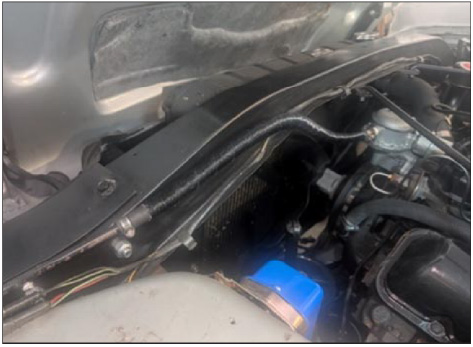
Figure 2
In the end, the bean counters were happy, but nobody else was. So, if chronic fuel system failures cause you to add an electric pump to your car, relax in the knowledge that this was how it was supposed to have been anyway.
Again, I didn’t want to drill a hole in my dash for a switch to operate an electric fuel pump. I began looking for an alternative solution while still keeping the car factory-original. What I found was a new fiberglass heat sleeve by Thermo-Tech. (Fig.1) The company has been around since 1986, and its belief in Thermo-Tech products has made it the number one source for heat-management solutions.
In my 1960 Lincoln Continental Mark V Convertible, there is a 3/8“ diameter rubber fuel hose, approximately two feet in length, that runs from the metal fuel line up front to the fuel pump itself, which needs protection from excessive heat. So, I ordered the following:
QTY:1
Code/SKU: 17063
Product Name: Thermo-Flex Sleeve
Color: Black
Size: 5/8″ x 3ft
Price: $23.50
SH: $5.00
Grand Total: $28.50
The rubber fuel line that needs protection is 3/8” in diameter. Sliding the 5/8“ Thermo-flex shield sleeve over the rubber fuel line makes for a nice and snug fit. By ordering three feet of the flex sleeve, I had one foot left over, which I then used to encase the metal fuel line from the fuel pump filter to the carburetor. (See Fig. 2) Since installation, I have not experienced another vapor lock issue. What a great find for only $28.50!
Dean Forbes is an LCOC member from Houston, Texas.